Kintsu Lending Launch on Canton Testnet
Canton is becoming a serious venue for tokenized capital.
From the DTCC issuing US treasuries natively onchain, to Goldman, JPMorgan and other Banks, FIs, custodians, market infrastructure providers, asset issuers, and trading firms are already building and operating on the network. Tokenized assets are arriving. Settlement infrastructure is maturing. The next question is what those assets can actually do once they are onchain.
Today, we are launching Kintsu Credit on testnet.
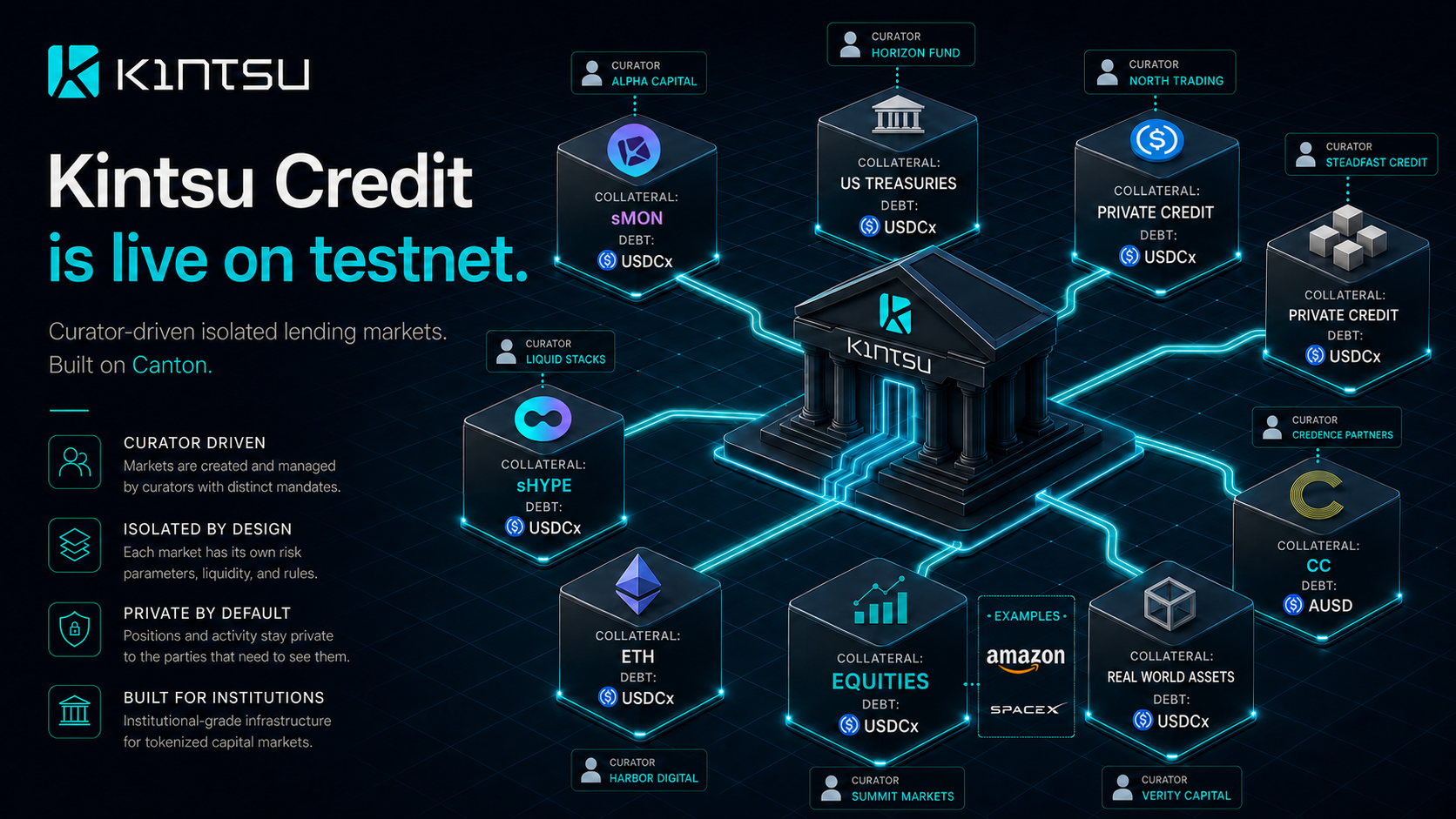
Kintsu Credit is a curator-driven lending protocol built on Canton Network. It allows asset managers, issuers, and market participants to create isolated lending markets around specific collateral, risk parameters, and capital mandates.
This is an important step, but it is still a testnet launch.
The purpose of this phase is to open the protocol for testing, validate market mechanics, onboard initial curators, and prepare the first production markets for mainnet.
From liquid staking to credit
Kintsu started with a simple idea: capital securing a network should remain productive.
That led us to liquid staking. Users could stake an asset, receive a liquid representation, and continue using that capital elsewhere.
But liquid staking is only one layer of the capital stack.
A productive asset should also be able to serve as collateral, support borrowing, earn lending yield, and move across strategies. Credit is what turns a tokenized asset from something that simply exists onchain into something that can participate in an actual capital market.
Kintsu Credit is the next step in that evolution.
Why Canton
Institutional credit markets require more than shared settlement.
They require control over who can see a position, who can interact with a market, how risk is defined, and how sensitive information moves between counterparties.
On most public blockchains, positions, balances, liquidations, and strategy changes are visible to everyone. That model works well for many DeFi applications, but it creates real limitations for institutions, asset managers, and market makers that cannot expose their books or trading activity publicly.
Canton is designed differently.
Its privacy model allows participants to share a network without exposing every transaction to every other participant. A lender does not need to see every borrower position. A competing market maker does not need to see your inventory. A curator can manage a strategy without broadcasting every internal decision.
The network remains interoperable, while market data remains visible only to the parties that need it.
That architecture is a strong foundation for programmable credit.
What is different about Kintsu Credit
Kintsu is not the first DeFi-style lending protocol on Canton.
Our approach is different.
Kintsu Credit is designed around curator-driven, isolated lending markets.
Each market is a separate risk environment with its own:
collateral asset
borrow asset
loan-to-value parameters
interest rate model
oracle policy
supply and borrow caps
liquidation design
access and compliance rules
A curator defines the mandate and manages the market within those boundaries.
That creates a model closer to an asset management product than a single shared lending pool.
Lenders are not simply depositing into a generic protocol. They are selecting a curator, a collateral policy, and a risk mandate.
Borrowers gain access to credit against specific assets without exposing their full position to the broader network.
Issuers can work with curators to design markets around newly tokenized assets.
Isolated markets by default
Risk in Kintsu Credit is contained at the market level.
A problem in one market does not automatically spread across every other asset or lender in the protocol. Each market can be designed around the liquidity, volatility, custody, oracle, and liquidation characteristics of its collateral.
This matters because tokenized capital markets will not be built from one universal pool.
Treasuries, equities, crypto assets, private credit, liquid staking tokens, and other tokenized instruments each require different risk assumptions.
Kintsu is being built to support that diversity.
Curators as a distribution layer
The curator model is not only about risk management.
It is also a go-to-market model.
Asset managers, credit funds, issuers, and specialized trading firms can use Kintsu to launch lending products without building an entire protocol from scratch.
A curator can define a mandate, attract capital, manage allocations, and earn fees for doing so.
An asset issuer can work with a curator to make its token more useful as collateral.
A lender can access a strategy through a familiar risk manager rather than underwriting every market independently.
Over time, we expect Kintsu to support a broad ecosystem of specialized markets and curated vaults, each designed around a specific source of collateral, yield, or credit demand.
Privacy without sacrificing composability
Private markets often become isolated systems.
Public markets are composable, but expose too much information.
Kintsu is built around the idea that privacy and composability should not be mutually exclusive.
Markets can remain connected to the broader Canton ecosystem while preserving sensitive data at the transaction and participant level.
That means tokenized assets can move between custody, settlement, lending, and investment applications without forcing institutions to publish their books.
Privacy is not an add-on to the protocol. It is part of the market structure.
What is live today
The Kintsu Credit testnet includes the core lending flow:
creation of isolated lending markets
collateral deposits
borrowing and repayment
lender deposits and withdrawals
curator-defined market parameters
interest accrual
frontend market interactions
Canton-native settlement
The first test markets are intended to validate the protocol under real user workflows before production capital is introduced.
This phase is also where we will refine curator tooling, market configuration, onboarding, and the path from testnet markets to mainnet deployment.
What comes next
The next phase is private mainnet.
That will include the first production markets, initial curators, early lenders and borrowers, production infrastructure, and targeted incentive programs.
From there, Kintsu will expand toward:
public access to markets and vaults
broader curator and issuer onboarding
additional collateral types
institutional custody integrations
automated market workflows
a wider network of capital providers, market makers, and distribution partners
The goal is not to recreate a public lending protocol on a private network.
The goal is to build a credit layer for tokenized capital markets.
One where markets can be launched around specific assets, managed by accountable curators, accessed by professional capital, and connected to the wider financial system without exposing every position to the world.
Kintsu Credit is now live on testnet.
[Explore the testnet →]
[Apply to become a curator →]
[Read the first market brief →]